Most businesses that call an AI consultant have the same two questions and rarely ask either out loud. What will you actually do? And how do I know you will not sell me something I do not need? This article answers both, in the order the work happens. It is written for owners and operators, not engineers, and it describes what Cygnik Tech does because that is the only practice I can describe honestly. Where the honest answer is "we will tell you no", it says so.
One thing to know first. Everything below is the same method we used to build our own products, Lanexa, PageSight and Cygnik Store, on the same AI stack we deploy for clients. We did not write the method and then look for proof. We built the proof and then wrote the method down. The founder's account of that build is on LinkedIn; this page is the client's side of it.
1. The objective comes before the technology
In its current state, AI is an amplifier, not a compensator. It will amplify whatever you point it at, in whatever direction you aim. What it will not do is compensate for an objective you have not defined. Point it at a vague goal and it produces confident, wrong work at speed. Point it at a precise one and it produces work you can run a business on.
So the first two weeks of any engagement are spent on the objective, not the model. We map the workflows your team repeats, score each one on cost, frequency and risk, and agree in writing on what "done" means as a number: hours returned, errors removed, days off a cycle. That written objective is what we price against. Not hours, and not a standing retainer by default. If the objective will not pay back what it costs to reach, we say so at this stage, before you have spent anything on a build.
2. We look at how the work is actually done, not how it is described
Every business problem loses something on the way from the person living it to the people building the fix. It gets summarized, then translated, then summarized again. What an AI system needs most is context, as much of it as possible, and context only comes from observation: someone watching the dispatcher at 6 a.m., reading the actual rate confirmation PDF, noticing which column the bookkeeper ignores and understanding why.
That is what we do in discovery. We sit with the people who do the work, read the real documents, and write down what happens rather than what the process chart says happens. This matters more now than it ever did, because AI has changed who can instruct a machine.
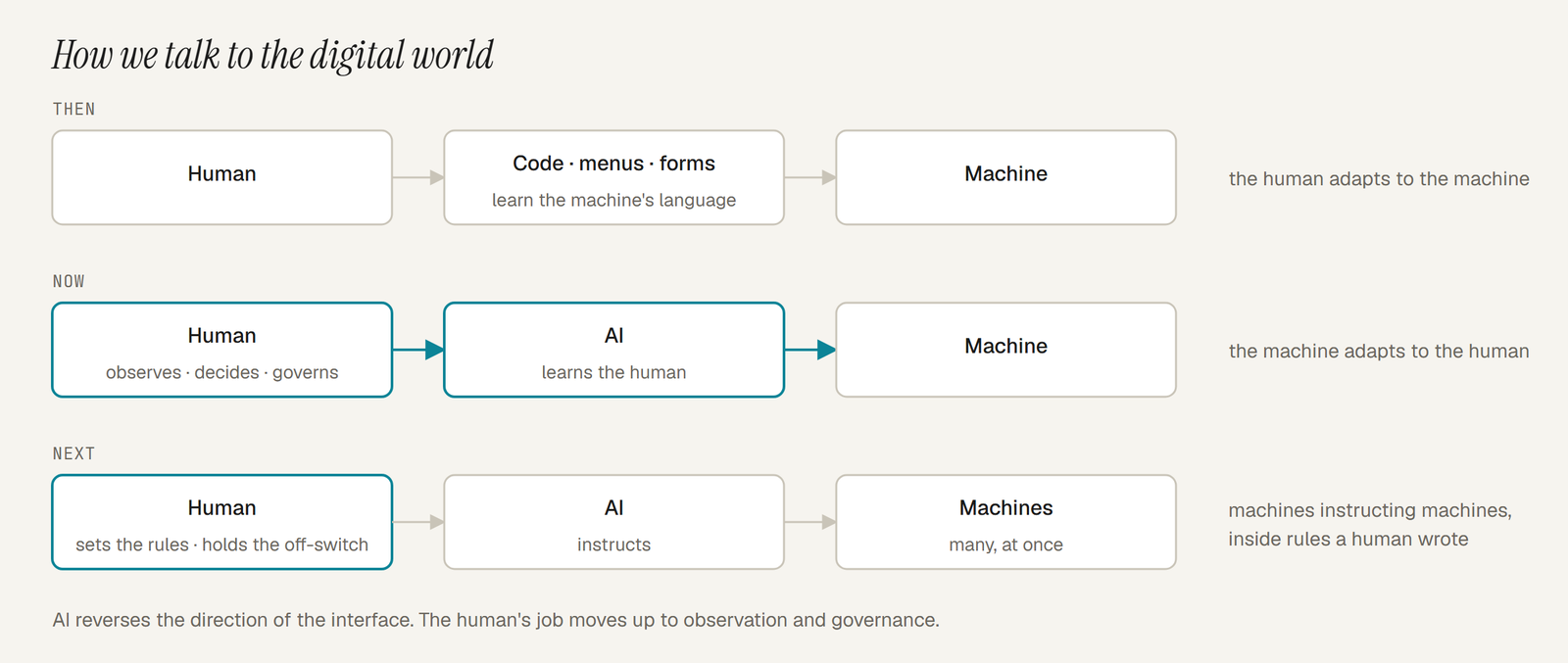
The consequence for you is simple. The person in your business who understands the problem best is now the most valuable person in the project, whether or not they have ever written code. Our job is to observe with them, turn what they know into a precise brief, and keep the machine pointed at it.
3. We build one workflow at a time, on your real data, in shadow mode
Nothing we have put into production came out of one clever prompt. It came out of rounds: build, test, find what broke, document it, review it with your team and ours, recalibrate, run again, until the error rate is one you can live with. The discipline is in the loop, not in the wording.
In practice that means a workflow ships in shadow mode first. It runs alongside your existing process on real inputs, producing output that a named person on your team reviews, and nothing it does reaches a customer or a ledger until that person is satisfied. Only then does it go live, and it goes live with that reviewer still attached. A typical workflow takes four to eight weeks from brief to live, and the same loop continues after go-live, because the models change and your business changes.
The best first project is high-cost, high-frequency and low-risk: boring, repetitive work where a human still signs off.
4. What you own when it is done
Three things can take an AI system down that have nothing to do with the work it does: the model's price changes, its speed drops, or it is simply unavailable one morning. Any of those can happen to any vendor in any given week. A system that depends on one provider is a system with a single point of failure you do not control.
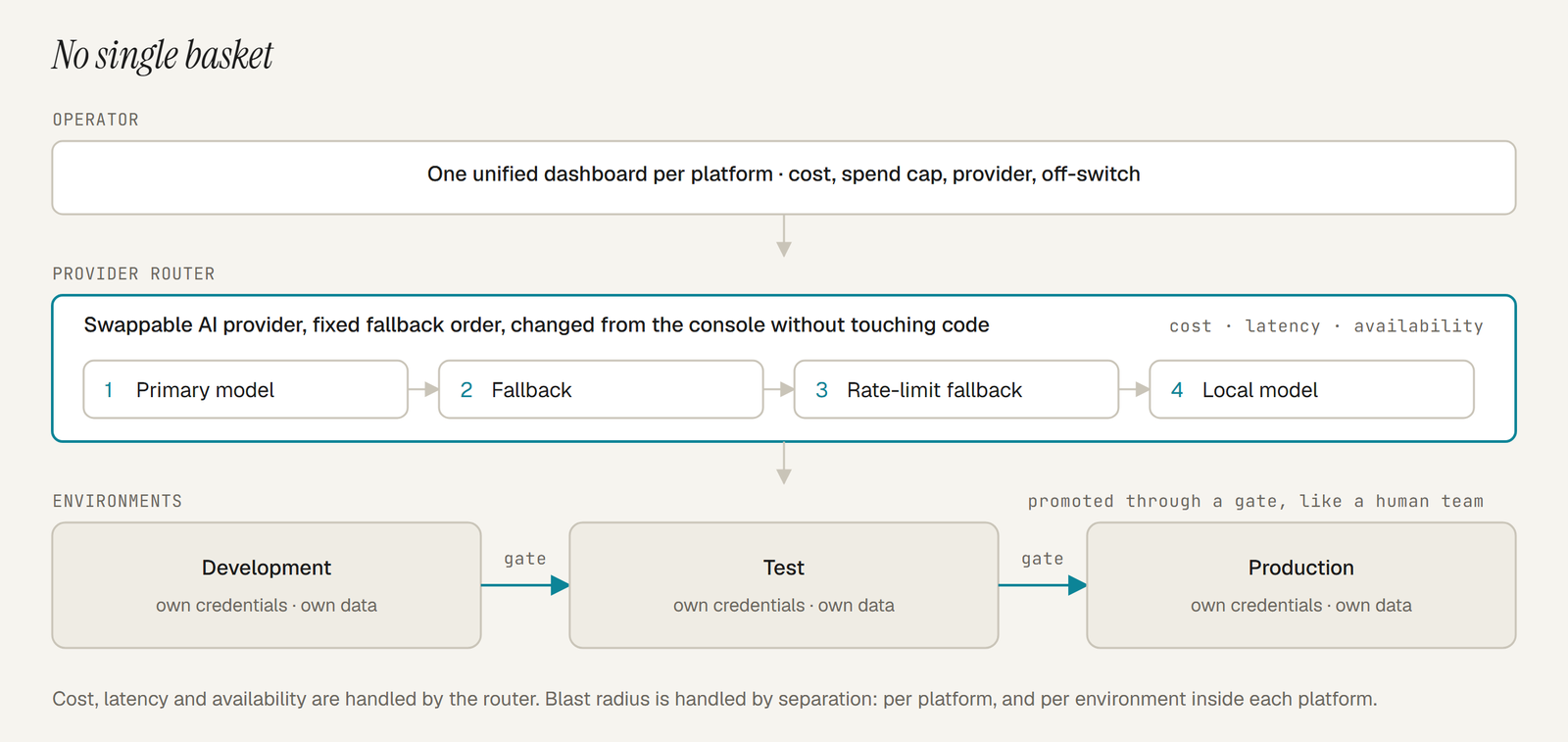
So every system we deliver ships with the same set of things, and they are yours:
- A swappable AI provider with a fixed fallback order, changed from an admin console, not from code. Sensitive or high-volume work can run on a local model on infrastructure you control.
- Your data where you choose. Canadian hosting where it matters, and never in someone else's training set.
- A spend cap that fails a task rather than overspending. AI is the first recurring marginal cost most businesses have added in years, and it is guarded hardest.
- An audit trail and an off-switch you can reach without calling us.
- Separate environments, so nothing reaches production by accident and every change has a place to be tested before anything real is at stake.
We can run the system for you on a monthly retainer. Nothing about the system depends on that. No lock-in is a design decision, not a pricing line.
5. What we will and will not connect to
If there is one area where ignorance costs a business the most, it is this one. An AI agent will do what it has permission to do, and most permission is implicit: a key left in a configuration file, a token scoped wider than the task, a service account that was convenient a year ago. The agent does not know those were accidents. It treats them as authority.
We learned this on our own systems, not a client's, when an agent deployed into an account it was never told to touch, because the credentials it inherited reached it. Nothing in its instructions said to. Nothing in the environment said it could not. So our rule is explicit permission only. Before an agent touches anything of yours, it gets a written list of exactly what it may do: these tables, these two connections, this queue. Everything not on the list is not permitted, whatever your environment technically allows. Access used during a build is rotated before go-live, and every connection is monitored afterwards. Defining that line is most of AI security for a business. The rest is monitoring.
6. Who on your team owns the output
Accountability does not transfer to the AI. If a quote goes out under your company's name, your company is responsible for it, whether a person typed it or an agent drafted it. So before any agent ships we answer four questions with you, not after: who owns the output, who reviews it, what the policy says when it is wrong, and how we will know when it is drifting.
"Review" has to mean something. Most of what the industry calls a human in the loop is a person approving an algorithm's output under time pressure, with incomplete context, because there is pressure to move fast. That is automation bias with a human signature attached, and we have caught ourselves doing it. The mechanics we put in place for you are plain: the reviewer gets the context, not just the output; customer-facing work is reviewed with no clock running; the reviewer can reject without justifying it in the moment; and where the stakes are real, the reviewer is never the person who set the agent up. A human in the loop only counts if the human could actually have said no.
7. Where we will tell you no
Most AI consultants oversell, and the incentive is obvious. Our practice is structured the other way: fixed-fee engagements against a written objective, vendor-neutral recommendations, and a willingness to walk you out the door with "do not do this" and a refund of the unused fee. Three cases come up often.
- The work is rare, judgement-heavy or relationship-driven. A once-a-year filing, a complex negotiation, anything where the rules live in one expert's head and change every time. Do not automate this yet.
- The workflow will not pay back. A daily task that costs staff time pays back a build in weeks. A monthly one rarely justifies it. We show you the arithmetic before you spend.
- The foundation is not ready. AI runs on top of your IT, not instead of it. If access control, backups or the network are not sound, that comes first. We came up through managed IT services, and we still do that work for clients who need it.
And a broader honesty. Governance and security for AI systems are early. The permission model, the spend caps, the audit trail and the off-switch above are things we had to build ourselves, because very little of it exists off the shelf and the standards are still forming. For most businesses, adoption and return are still ahead. The gap between what is now possible and what has actually been adopted is exactly where an honest consulting practice lives, and anyone who tells you it is a solved problem is selling something.
8. How to start
The sequence is the same for a ten-person firm and a three-hundred-person one. Discover: two weeks of workflow mapping, scored on cost, frequency and risk, ending in a written objective. Model: the return, the agent's behaviour, and the governance rules, with named owners and intervention points. Ship: four to eight weeks per workflow, shadow mode first, then live with a named reviewer. Run: monitoring, retraining as models change, and a one-page monthly report if you want us to keep operating it.
You can read the full method on our approach page, see the products it produced on case studies, and try the discovery conversation itself, free and with no sign-up, at cygnik.tech/discover. It asks about your business, scores where AI is likely to pay, and tells you where it probably will not.
Frequently asked questions
What does an AI consultant actually do?
Defines a measurable objective with you before touching technology, observes how your work is actually done, builds one workflow at a time on your real data with a named reviewer, hands you a system you own, and tells you plainly when AI will not pay back. A bad one sells a platform first and looks for a use case later.
How does Cygnik Tech charge?
Against an objective agreed in writing, as a fixed fee. Not hours, and not a standing retainer unless you want us to operate the system afterwards. If the objective will not pay back, we say so before you spend.
Do we have to give you access to our systems?
Only the access the task needs, scoped and written down before any agent touches anything. Everything not on that list is not permitted. Access used during the build is rotated before go-live.
Who owns the AI system afterwards?
You do. The provider is swappable from your own console, your data stays where you chose, and the environments, audit trail and off-switch are yours. We can run it for you; nothing depends on that.
What if AI is not right for us?
Then discovery ends with a "not yet" and a refund of the unused fee. Being told no early is one of the most useful outcomes an engagement can have.